How to Find Blog Inspiration

There are a million cozy vlogs out there about fiction writing. Unfortunately, there is much less out there about how to feel inspired about a different kind of writing: your blogging practice. If you’re a blogger, whether professionally or as a hobby, you might occasionally feel drained or bored with your blogging. Here’s a guide on getting inspired and excited!

A note about inspiration itself: every writing book and teacher out there says that if you WAIT to write until inspiration strikes, you’ll never be consistent enough to improve. This is true. However, that doesn’t mean that writing has to be drudgery– inspiration can be a source of FUN, in addition to new ideas! Rather than letting these activities be fuel for procrastination, do them in your free time and NOT when you’re supposed to be writing.

Read your favorite blogs.

Go to your bookmarks or email inbox and click on those blogs you return to again and again. They don’t have to match your blog’s topic. See if they have any new posts and catch up on the blogger’s personal life, industry news, or topic trends. Spend a while just reading for fun, but make sure you have a receptacle ready for any ideas that might spark. Comments are almost always welcome!

Not only is this good research that can help you figure out what direction to take your own blog, but it might remind you of why you’re blogging in the first place– whatever that reason is.

Obviously, do not plagiarize anyone else’s work. I’m not saying you should copy what they wrote. If you decide to write something as a response, please give credit where credit (and backlinks) where it is due!

Write some affirmations and repeat them with gusto.

If you’re feeling “blah” about your writing practice, it might be because of negative beliefs you have about the process and its possible outcomes. To combat this, write down some affirmations that reflect the way you want to feel about your blogging. It works better if you say them out loud with dramatic flair!

Make a YouTube playlist.

Once again, I am not saying to plagiarize. Instead, get inspired by making and watching a YouTube playlist. It can be about your blog’s niche topic or anything else you want to learn about. Learning, in a way that’s fun, gets our brains warmed up before the task of writing begins.

Journal for a week.

Journaling is helpful in a huge variety of ways, depending on how you do it. In the short term, it can get you into a writing flow, but in the long term, it can also be mined for inspiration. Write whatever you want (in a notebook or app) every day for a week and then reread what you wrote. What themes keep popping up? What was on your mind a lot? What opinions do you have? The answers to these questions can all lead to blog posts.

Get out of the house.

This is a classic tip, but it works. Take a break from writing and leave the house. Going for a walk can be just the right solution, but I find it even more effective to go somewhere there are people to interact with, like a coffee shop or a restaurant. You don’t have to have a long conversation with someone to be intellectually stimulated by your surroundings– just order a drink and hang out.

Read a book.

I am not going to say that getting off of screens is the most important part of reading, because many of us read using digital devices! Rather, I am of the opinion that books go in-depth on a topic in a way that other media rarely does. Get a solid nonfiction book (about your blog topic or something else) that interests you and see what doors open in your mind.

Talk to someone else about writing.

Often, talking to others about something that’s on our minds can help our brains make connections that they wouldn’t otherwise. Make a date with an IRL friend who likes to write or participate in online discussions. You can talk about writing woes or writing wins, or both. Read and then gently critique each other’s writing, or plan your next steps together.

Writer’s Block: A Quick Solution

Many writers treat writer’s block as a punishment handed down from on high. There are all sorts of superstitions about how to cure writer’s block, and while they might work for their espousers, they seldom work for anyone else.

There is a reason why it is called writer’s block and not photographer’s block. While all arts are challenging and take skill and persistence (it’s not a contest!), writers often have longer works over a period of time (whether that’s a fiction book or a collection of shorter works) that require them to make more decisions. After all, anything can happen in a story, and the initial premise often doesn’t completely decide where the plot is going. Even if it’s not a story, most written forms do have some sort of narrative, and there are lots of decisions to be made.

Writer’s block is ultimately the refusal to make a decision. There may be many good reasons for that, and I’m not here to judge you, but it is not an inability. It’s not a supernatural malady that has struck you, and it’s definitely curable.

To combat writer’s block, I recommend intentionally making a decision about your work. It could be a big decision (which often resolves the problem entirely!) or it could be a small decision just to get jump-started. I recommend recording this decision in a journal or a notebook (maybe one you have dedicated to the project?) just to get it down and out of your head. If you’re not sure what decision you want to make, you can freewrite or journal or type about it (in a separate document!).

Notice that the title of this post is a “quick” solution, and not an “easy” one. There is no easy path to take when you’re making a decision about your work. It might feel like pulling teeth. Reaching down deep within yourself and making the right decision for you is a skill that you have been developing (purposely or accidentally) throughout your whole life.

Remember, you are going to edit anyway. If your decision turns out to be a mistake, you can reverse it!

Coming up soon is my book on how to write poetry for beginners, based on my experiences in an undergrad Creative Writing program and as a professional writer. Stay tuned!

Intro to Fountain Pens– for Cheap!

Fountain pens? Why, when ballpoint or gel pens are available, would you spend extra money on something as frivolous and anachronistic as a fountain pen? At first glance, it seems silly to spend exorbitant amounts of money on a single pen, but it’s definitely possible to get into the hobby for much less than $50.

If you care about your hand-writing experience, I highly recommend experimenting with fountain pens. Let’s look at what you need to know to get started.

Note: NONE of the links in the following article are affiliate links. I make no advertising revenue on this blog. If you would like to support the blog, you can sign up on Patreon!

Why use Fountain Pens?

  1. They provide an unbelievably upgraded writing experience. If you’ve ever used a fountain pen, you know that they provide a much better flow and feel deliciously smooth on the paper. If you haven’t, I recommend getting the cheapest possible supplies and doing some experimenting. It’s like painting with a paintbrush versus scribbling with a crayon, even at lower price points.
  2. You can customize your writing with fun and fancy inks. If you’re sick of plain black or blue ink (which I am not personally, but if you were it would be understandable!) there are a PLETHORA of inks out there, in every color you could imagine. Some even have glitter (called shimmer), or change color where they pool (called sheen).

How to Get Into Fountain Pens— For Cheap!

What to Buy

  1. The pen. If you don’t want to make a large monetary commitment, you can get a fountain pen for less than $10, like from the Jinhao brand. The upgrade in writing experience is immediate, even with cheap pens. If you already know you like fountain pens, I have heard great things about the Lamy Safari, which is less than $30 and comes in an array of colors.
  2. Ink. If you want to experiment with many different inks, you can pick out samples or get random ones from Goulet. My favorite ink for everyday use is Parker Quink in black. It is quick-drying so it’s less likely to smudge during normal writing.
  3. Optional: converter. Depending on the pen you buy, you may need a separate piece to hold the ink inside the pen. The Jinhao brand seems to come with them, but if you get another pen, you should bear in mind that you might need it. Do your research on the model of pen you want to get!
  4. Optional: blunt syringes. Depending on the pen you get, you may need to fill the converter or the ink chamber with a blunt syringe. Getting syringes also allows you to use any ink samples you may get, because you probably won’t be able to dunk your whole pen in the small vial to fill it up.

Let me know if you end up experimenting with fountain pens and how it goes! Have fun writing!

How to Create a Reading Journal You’ll Actually Use

Reading journals have become big business recently, in large part because of a growing movement that promotes mindfulness in a hectic world. Whether you read paper books, ebooks, or audiobooks, it can be extremely valuable to track your reading. However, it can be hard to get started and even more challenging to keep with it.

Here are some of my thoughts on reading journals.

Reasons to track your reading:

  • you want to remember what you read.
  • you want to get more thoughtful about books.
  • you need a place to take notes from the things you read.
  • you want to make sure you’re reading a variety of genres.
  • you want to connect with other readers by writing reviews on GoodReads, StoryGraph, or a blog.
  • you want to read a certain number of books in a certain time frame.
  • you’re curious about what books you gravitate towards.
  • you’re curious about what tropes you like.
  • you want to compile a list of your favorites.

Got more reasons to keep a reading journal? Let us know in the comments below!

Pre-Made or Bullet Journal Style?

There are a ton of pre-made reading journals out there, to the point that, despite oodles of reviews online, you may find it overwhelming to try to pick one. In that case, I recommend making your own!

The rest of this article will deal primary with make-your-own reading journals, with a heavy influence from the Bullet Journal Method.

Think: what is the purpose of your reading journal?

The main purpose of my reading journal is to remember what I read, because I have memory issues. I often feel like I don’t know what I did with my time, including what I read, so I keep track. I also like to give myself credit for all the reading that I do before I decide a book is not for me, so I even keep track of books I started but didn’t finish!

Yours might be different, and become a place to list all the exciting things you might read next! Or maybe you’re goal-oriented and want to see how many books you can finish in a year! Or maybe it’s primarily an art journal! The possibilities are endless.

My point is, it’s important to choose a primary reason for your reading journal so that you know what to include or which one to buy, if you’re taking that route.

Here are some reading journal page ideas, from my own reading journal:

  • A title page. I recommend that this have your name and contact info in case it’s lost, as well as the dates the journal covers. That way, in the future, you can easily find what you read by time period.
  • A Table of Contents like in the Bullet Journal Method. I only include pages I will want to reference frequently, but you may choose to include everything.
  • A running list of the books you have finished. For me, this is a simple numbered list with the book’s title, author, and the date I finished it. I make a new list for each year.
  • A reading log. This is different than the books you’ve finished, because it’s arranged by date and chronicles books you may not have finished. I don’t always finish the books I’ve started, and I still want credit for them, dammit! My reading log is a chart with the date, title, author, and a column where I can draw a star if I finished it that day. I do this particular chart with the notebook turned landscape so I have more room to write the title.
  • A library books tracker. For me, this is another chart with the title, author, three columns for me to write the due date, and a column to check off if I’ve returned it. In my library system, we can renew books twice, so I might need all three spaces.
  • A To Be Read, or TBR. Obviously! Make sure you write down both title and author.
  • A review template. Mine includes title, author, publication date, star rating out of five like on Goodreads, genre, diverse voices, and who I would recommend this to. If you like, you can also include the format (like ebook or audiobook). The rest of the page is divided into two columns: things I liked and things I didn’t like. I make a review page for each book I start and write in it as I go, but other people may choose to only do review pages for books that they have finished.
  • Review pages. My review pages are rewritten from the review template, and contain a big star if I finished it.
  • Book notes. You might be reading fiction or nonfiction– I know I read both– and either way, you might want to write notes. I often write chapter summaries for fiction. For me, these are separate from the review pages.
  • Quote pages. Sometimes a quote from fiction or nonfiction will really strike me, so I write it on its own page. Make it artsy if you like!
  • Vocabulary. If you’re an enthusiastic reader, you might not often come across words you don’t know the definition of, but when you do, you should definitely write it down and look it up! Camp Damascus stumped me with “gelid” and I have never really understood what “philology” is. If you keep a running list, you will avoid being stumped in the future and learn something new!
  • Recommendations you’ve gotten and who recommended them. Sometimes, the person doing the recommending matters a lot! You may have reviewers whose tastes match up with yours, or friends whose opinions you trust! I have a special page for books I was recommended through my single month of Tailored Book Recommendations. (I was so curious I had to give it a try, and I learned a lot about my own preferences just from answering the questions that the service gives you!)
  • A list of your favorite books of all time. For a challenge, try to pare it down as much as possible!
  • Least favorite book of all time and the book that challenged you the most. Mine are, respectively, Ethan Frome and Rosencrantz and Guildenstern are Dead.
  • DNF (or Did Not Finish) page, with a list of your DNFs and why you stopped reading.
  • Series lists, to keep track of each book in a series.
  • Finally, an index. Mine is in the back of the book and records titles as well as authors (by last name) and the pages on which they appear. I allotted about 10 lines per letter and just fill them in as I go.

Do you keep a reading journal? Have I missed anything? Let me know in the comments below!

How to Brainstorm Blog Post Ideas

If I had a nickel for every time I Googled this…

For some reason, I never feel like I have a handle on what blog content I want to write next. I am always looking for the next big idea, and usually I seek it in those exhaustive lists of blog post topics put out by those blogs-about-blogging. Lists populated by stuff like “7 Things Making Cabinets Taught Me About Marketing!”

The thing is, even if you’re blogging professionally, writing is an endeavor that connects humans together. People who read your blog value what YOU have to say. This may be because they already know who you are and value your thoughts as someone they respect, or it could be because of the high merit of the ideas you write about.

Blog about stuff you have real opinions/expertise on. (This does not mean you have to be an expert (whatever that means) before you can write a single word; in that case I recommend admitting that there’s a lot you don’t know and providing resources for people who want to learn alongside you.) Write from your own unique point of view, because that’s what readers want to see.

However.

Knowing that fact doesn’t necessarily mean you know exactly what to write about next.

There IS an exercise that I have found helps me when I don’t know what to write about. I discovered it recently from Little Coffee Fox, who got it from a book. Just write 100 things– it’s as simple as that. Number a piece of paper and free-write ideas until you get to 100. It’s both harder and easier than it sounds!

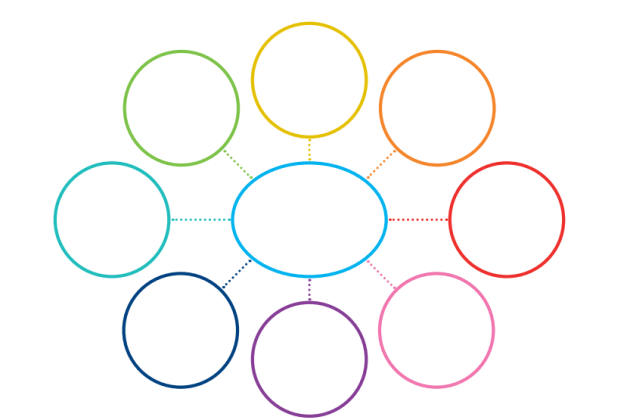
If you need more help, I recommend making a mind map. You’ve seen them, they look like this:

Each bubble can have more bubbles coming off of it, in an endless fractal of related ideas.

Put “BLOG” in the middle and make a bubble for each broad topic you want to write about. If you use WordPress, these may be your blog’s categories. Keep making bubbles outward in a circle until you get to topics small enough to be individual posts. For example, BLOG -> Dogs -> German Shepherds -> Training your German Shepherd puppy -> Supplies you need for training your German Shepherd puppy. Go back and add this to your list of 100 ideas.

If you need even more help than that, I recommend scrolling through YOUR OWN social media pages. What do you usually post? What have you ranted about recently? What did you share because you agreed with it? What did you share because you DISAGREED with it? What inspired you? I’m not saying to steal other people’s posts word-for-word, but the emotions and thoughts you have while scrolling social media can be a big clue as to what you could be writing about. Add any insights to your list of 100 ideas.

Once you have 100 ideas (which might take a few sessions, despite what Little Coffee Fox says) keep them in an accessible place. Add more if you think of them. Make more connections. Write. Always write.

Break a leg!

New Directions, Graduating Therapy!

I know I said this before, but I’m going in a new direction on this blog.

I have learned a lot and graduated from therapy, and I (maybe paradoxically) no longer feel like I have the expertise to advise anyone in mental health. While I had a lot of KNOWLEDGE about mental health (and especially dissociation), it wasn’t the same as wisdom. Obviously, graduating from therapy doesn’t mean that I am perfect, but I am definitely capable of putting into practice what I have learned– which is mainly that we need to feel our repressed feelings. Mine is generally anger. Even if I struggle, I usually have a much better sense of what exactly I’m upset about, which used to be a big hurdle for me. I would often feel nebulously Upset and be unable to figure out why or what to do about it. Even just figuring out the truth about my emotions and their roots can be powerful, and often neutralizes the emotional problem.

I said before that I wanted to write about masculinity, from the perspective of a trans guy. (Not necessarily the same as writing about being trans.) However, I am not the expert on that either.

So what direction AM I taking?

I’m going to write about whatever I’m thinking about. As someone who used to be a professional writer, I always think that I have to be monetize-able and professional on my blog. Fuck that. That doesn’t mean, however, that I am going to use this as a public diary. There’s nothing wrong with that, of course, but I am more interested in sharing my thoughts than my feelings. I do a lot of reading and research and I’m interested in sharing that.

Lately, most of what I’ve been thinking about is witchcraft and paganism. If that is something you’d like to read about, stick around!

I’m also going to grad school in January 2024 so I’m sure I’ll have lots of thoughts to share then. My major will be Library Science. I’ve been working in libraries for a total of like 7 years, so I feel pretty qualified to move up; I just need the degree.

Currently Reading: Amulet of Samarkand by Jonathan Stroud (a re-read of a favorite!)

Why You Should NOT Freelance as a Writer

Lots of people, upon finding out that I freelanced as a writer for about four years, ask how to make it work for them. I usually tell them it’s a terrible idea and that they should steer clear.

Yes, I will not lie, I had a bad time as a freelancer. Part of this, of course, was battling mental illness, but I think the stress and lack of structure really didn’t help.

I primarily used the site Upwork, which has the benefit of handling the money aspect for you so you don’t have to chase your clients down to get them to pay you. However, the site also has many downsides, which I will address below.

Here are some reasons you should NOT freelance:

The pay is not good.

Unless you are unusually savvy, you will start out with clients who want you to work for CHEAP. This is especially true if you decide to use Upwork, which markets itself to entrepreneurs who aren’t looking for experts.

Also, many clients will pay by the project rather than by the hour. This doesn’t sound so bad until you realize you’ll need to do your own research, adding time to your project. Even when you’re given what seems like a fair wage, there are often unforeseen hiccups that can extend a project’s time commitment, and you will not get reimbursed for those.

Getting out of this low-pay rut requires a significant amount of luck OR enough savings to be able to be discerning from the get-go.

You often don’t get to decide what you write about.

If you use Upwork, you will be applying to jobs where your clients already know what they want. While you may be able to nail down an area of expertise, your topics will usually be decided for you. (You will probably still have to do your own research.)

If you would prefer to write an article about something you care about and then sell it, you will probably make more money per article but sell them less frequently.

Income is not consistent.

Even if you’re making pretty good money, you will have highs and lows. This can make it hard to budget and save.

Likewise, time commitment is not consistent.

Sometimes, a client will need something urgently, or you will get more clients, and your workload will be huge. Other times, you will be ready to work, but have nothing available to work on. This feast or famine can be really stressful.

You constantly have to be selling yourself and looking for new jobs.

If you don’t like job hunting, freelancing is not for you. You must be constantly on the look out for new clients and new opportunities, and many people find this draining.

There are no worker protections or benefits.

Worker protections and benefits have been hard-won in the last two centuries, and when you freelance, you get none of them. With freelancing, there is no minimum wage. There is no healthcare. There is no Paid Time Off.

It’s hard to work alone.

When you go to a physical workplace, you will almost always have coworkers that share in the camaraderie of the grind.

I often use a strategy called body doubling, but that doesn’t happen in freelancing unless you MAKE it happen by teaming up with other people with similar work.

You have to motivate yourself because there’s no structure.

When you freelance, you don’t have a boss or a teacher to make sure you’re working steadily— or at all. You get up in the morning and YOU have to make the decision to sit down to work. This can be really tough. Often, freelancers struggle with procrastination.

If you are REALLY good at waking up at the same time every day and sitting down to work at the same time every day, you will probably have an easier time than I did. My schedule was all over the place, and I was just as likely to be working at 2am as at 2pm. I had absolutely no structure to my life, and my mental health definitely suffered for it.

You will OWE taxes come tax season.

When you work a regular job as an employee, taxes are automatically taken out of your paycheck, and you get a large portion back when you do your taxes each year. As a freelancer, you would have to keep track of your money and save your own taxes, to then pay the government what they are owed. It’s not fun.

It’s hard to relax when your home is your workplace.

Unless you have an extra bedroom whose door you can shut, you’re going to be looking at and worrying about your work even in your “off” hours. Trying to sleep in the same room as my desk really stressed me out.


Reasons you SHOULD freelance:

You’re totally serious about a career in copyediting and you like internet marketing.

If you are 100% dedicated to a marketing and/or copyediting career, then freelancing might be your cup of tea.

It’s not the same skillset as any creative writing you may have done, even for publication. The fundamental aspects of copyediting are different and have different goals. You may often be asked to dabble in social media and/or graphic design. If that sounds like fun, I think you should seriously consider a freelance writing career!

How To Start Writing Poetry

You want to write poetry, but you don’t know where to start.

There are two components to the art of poetry, the writing part and the reading part. The writing part is the part where you actually DO it. The reading part is how you get better. We’ll cover both here.

For the record, I have been through a lot of formal education in the art of both reading and writing poetry, so I know a thing or two about how it is taught. I don’t agree with absolutely everything that was part of my training, but also there were some good takeaways, which I will impart to you here for free!

I. WRITING POETRY

A. Some Notes on Permission

My first point here is that you do NOT need anyone’s permission to start writing poetry. You do not need to get a degree or even take a class. You do not need to Google it. You do not even need MY permission.

Secondly, your poetry does not have to be for anyone else. It doesn’t have to be “good,” it doesn’t have to be “publishable.” What matters is that you had fun and expressed yourself. (Yes, there can definitely be a type of satisfaction in getting really good at a craft and sharing your art, but that’s not what we’re talking about today.)

Really, you don’t need me at all.

However, I CAN help you get started. You will probably have an easier time and put less pressure on yourself if you don’t expect your poems to spring fully-formed from your brain. Instead, there is a trick for first drafts called Freewriting.

B. Freewriting

Freewriting is a little bit like dreaming. You set pen to paper (yes, usually analog writing is recommended) and you write literally anything that comes to mind. Yup, anything. It doesn’t have to make sense, it doesn’t have to be good or profound or true or anything else in particular. Don’t edit or cross anything out. Being fully uninhibited during the freewriting process takes practice, and it’s something I’m still working on myself, but I recommend giving it a try anyway and seeing what happens.

After you’ve filled a page or two, take a break and let your work breathe for a few minutes. Get up and do something else. When you come back to it, reread what you’ve written and highlight or underline what’s interesting. Maybe you made up a weird turn of phrase that you like, or you really nailed how you feel in a certain situation.

After you’ve selected the most interesting parts of your freewriting session, you can use the lines and phrases like fridge magnets to construct a poem. Don’t be shy: throw out or fill in absolutely anything you want.

Revise as much or as little as you want. Sometimes it feels great to get the accuracy that comes with editing, while other times it can feel stifling. Read it out loud to yourself if you want. Do exactly what you want to do at all times in your poetry journey. It’s YOURS.

II. READING POETRY

If you want to get better at poetry and expand your capabilities, I highly recommend reading poetry. Luckily, this is not as intimidating as it might sound.

In my personal opinion, it can be important to read more modern poets, from the last 70 years or so. For one thing, their work is often more accessible. For another thing, there is more diversity in the demographics of the writers and their subject matter. Thirdly, if you’re super serious about writing to publish, it will show you current trends in the poetry world.

A. How To Read Poetry

What is the best WAY to read poetry? There isn’t one. Focus on getting as many words into your brain as possible at first— you can analyze later as your instincts get honed into skills. Soon you will notice meter and slant rhymes and all that other stuff, but for now you can just read for enjoyment.

You may want to try reading your favorites out loud to hear how things sound. This may add another layer to what you already liked about the poem!

You may also want to buy your poetry books so you can write notes or highlight in them.

B. Reading Suggestions: Where To Start

(I had fun with these suggestions, but that doesn’t mean these aren’t good places to start!)

If you’re queer and you’re not shy about the sexual, read Allen Ginsburg.

If you like nature and Abraham Lincoln, read Walt Whitman.

If you care about Black Power, read Nikki Giovanni.

If you’d like something accessible and easily digested, read Rupi Kaur.

If you love nature and enjoy feeling at peace, read Mary Oliver.

If you’re sad and feeling kind of feral, read Sylvia Plath.

If you like rhymes, read Robert Frost.

(Everyone should read Joy Harjo.)